Indrajatra is Nepal’s most important religious, artistic, and major road festival, particularly within the Kathmandu valley, and is substantially observed by the Newar community. Yenya means” Kathmandu festival” in Nepal Bhasa. It’s when the appearance of the showers( August to September in Solar timetable) is extensively known within the name of the rain god’ Indra.’

When is Indra Jatra celebrated?
Indra Jatra is an indigenous festival in the Kathmandu Valley in Nepal. This festival takes place on the 15th day of Yanla, the 11th month in the Nepalese timetable. This is an important harvesting festival in Kathmandu Valley, also known as Yenyā( meaning” Kathmandu festivity”)
History of Celebrating IndraJatra?
Looking at the legend, there’s a saying that Lord Indra, the Hindu God and King of heaven, formerly came on earth disguising himself as a farmer. He came in hunt of a flower parijat( night jasmine) for his mother Basundhara to perform a ritual. But people saw and caught him while he was plucking the flowers at Maruhiti, a sunken spout at Maru. The people took him as a common robber and put him on display in the city forecourt of Maru in Kathmandu. ( In Jatra, this event is reenacted by an image of Indra with his hands and two hands bound to be displayed at Maru and other places in the festival.)
Indra’s mother got feared due to his long absence, so she came to Kathmandu and wandered around looking for his son. ( In Jatra, this event is commemorated by the procession of Dagin through the city. Also, Pulukisi/ Tanakisi, an impersonator of an elephant, also runs around the city in search of his master.)
After the people realized that they had captured Lord Indra himself, they instantly released him. Indra’s mother became thankful to the townsmen for releasing her son, and she promised to give enough dew throughout the winter for the rich crop. There’s a belief that Kathmandu started to feel foggy morning from this celebration onwards because of this boon.
How Indra Jatra is celebrated?
Every year, Indra Jatra festival started after the erection of a long pole obtained from a single tree trunk in front of Kal bhairab statue in Hanuman dhoka area. This single tree trunk is brought from the forest of kavre district. Before cutting down the tree trunk, they choose the tree from the forest, then at midnight, they pray to the god with the sacrifices of goats, then chop down the tree and bring it into the city.
In earlier days, they brought the long pole by pulling from Kavre to Kathmandu by using a rope involving lots of people, But Nowadays, it has been changed, and the pole is pulled by the tractor where the wheels are put on the pole.
Then, the pole is dragged all over the ancient Newari city and placed back in the Hanuman dhoka Durbar square.
Officially this Jatra started after raising the pole in front of Hanuman dhoka durbar square. At the time of raising the pole number of priests and court astrologers, along with a huge number of people, were there to worship it. When the pole is tugged and pulled, many guns roar in solute music blares by the soldiers.
Similarly, the major highlights of this Indra Jatra festival always have been the chariot procession of living goddess Kumari, Ganesha, and Bhairava, along with the white eirawat elephant of Lord Indra called Pulu Kishi and the road dance of red-masked Lakhey. Numerous other inversely instigative masked dances are performed representing gods and demons. Then ultimately, on the last day of Jatra, the Linga or pole is pulled down, declaring the end of this festival.
Major highlights of Indra Jatra are
- Kumari Jatra
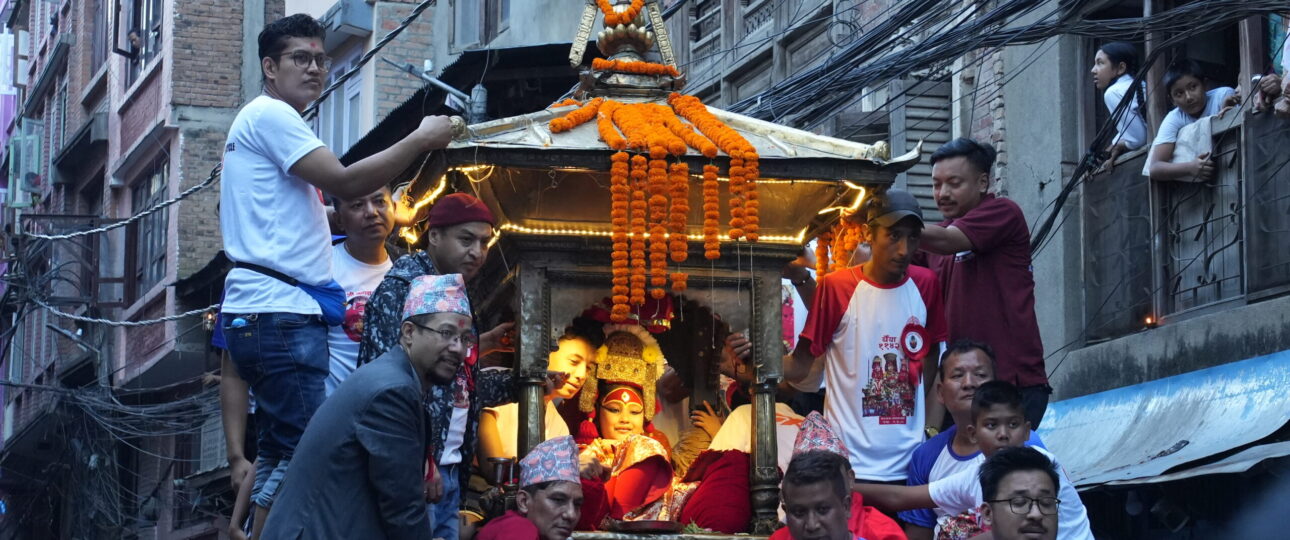
Indra Jatra is one 13 times a year when the Goddess Kumari leaves the seclusion of the Kumari Ghar. The chariot procession of Kumari, the Living Goddess, is dragged along with two other golden chariots carrying the human descriptions of Lord Ganesh and Lord Bhairava. All three chariots are manually dragged through the narrow alleys of Kathmandu with ten or other individualities.
The chariot procession is accompanied by classical dancers, musicians with loud musical instruments, and masked dancers known as Lakhey, who dress up as divinities and demons in traditional costumes and masks. The procession will only stop in front of 12- foot masked white Bhairav for Kumari to salute him. The procession begins around 3 p.m., and people march around with chariots to cherish the soul of their departed cousins. The groups of women pull the chariot of Kumari.
- Bhairab Mask display
Another major attraction of Indra Jatra is the valley’s Bhairav masks. This includes the Aakash Bhairav and the most dangerous face of Lord Shiva, White Bhairav or Swet Bhairav. The white Bhairav is displayed in front of Goddess Kumari’s Chariot procession. This Bhairav is only shown to the public once a year and lasts over three days. The White Bhairav is huge and chases with the bejeweled mask having a huge saucer. The silverware mask that the great king of Nepal, Yalambar, wore to the war is also displayed. Apart from the huge Bhairav mask of Hanuman Dhoka, all the alleys of Kathmandu Valley are filled with the locally- made Bhairav mask, signifying that Goddess Kumari is protected by the Bhairav wherever she goes.
After Goddess Kumari stops to greet and pay respect to the White Bhairav Mask, ‘ Jad,’ a typical Newari beer, starts pouring from the mask. The devotees believe that taking a belt of the Jad will bring them good luck. Likewise, a goldfish is kept in advance, and also believed that the one that gets the goldfish while sipping the Newari beer will earn good fortune and luck throughout the time.
- Dances and Exhibition in Indra Jatra
Several masked dances and exhibitions in Indra Jatra excite the celebration of the festival. You can see masks of Bhairva, a fearsome aspect of Lord Shiva, on display in numerous places in Kathmandu throughout the festival’s eight days. A mask of Aakash Bhairavam, images of Indraraj Dyah, avatars of Lord Vishnu, and masks of other gods. Major masked dances performed in these festivals are:
- Pulu Kisi: This dance is popular as an elephant Dance. In this dance, pulukisi goes on the street to search for his master Indra, knocks anyone in the way, and swings its tail looks amazing.
- Majepa lakhey : This is a demon dance performed on the streets and market squares during Indra Jatra festivals.
- Sawa Bhakku: This is a group dance that relates to god Bhairava. During this dance, Bhairab is performed with his two attendants.
- Devi Pykhan: In this dance, dancers were masks of various gods and goddesses and performed at different places near Hanuman Dhoka.
- Mahakali Pykhan : This dance features costumes representing Khyah, a fat, hairy ape-like creature.
4. Mate Biye
Mata Biye another cortege of Indra Jatra. The meaning Mata Biye means to offer butter lights. During the first day of chariot fest, Kwaneya, the Newars, honors their departed family members in past times by offering small butter lights along the recessional route.
5. Dagani
During the procession of Goddess Dagain, there’s a reenactment of Indra’s mother going around the city searching for her son. The procession consists of men wearing a mask along with a musical band. Dagain procession starts when the chariot of Kumari returns to Maru after touring around the southern part of the city.
It starts from an alley at the southwestern corner of Maru square. It passes by the western side of Kasthamandap, continuing to the southern end of the city before returning to Maru. The participants of this festival follow the festival route.
- Bau Mata
This procession of Indra Jatra consists of a long representation of a holy snake made of a wimp on which a row of oil painting lights is placed. The effigy is suspended from poles and carried on the shoulders taking along the festival route. Bau Mata procession starts when the Dagin procession returns from the upper part of the city and reaches Maru.