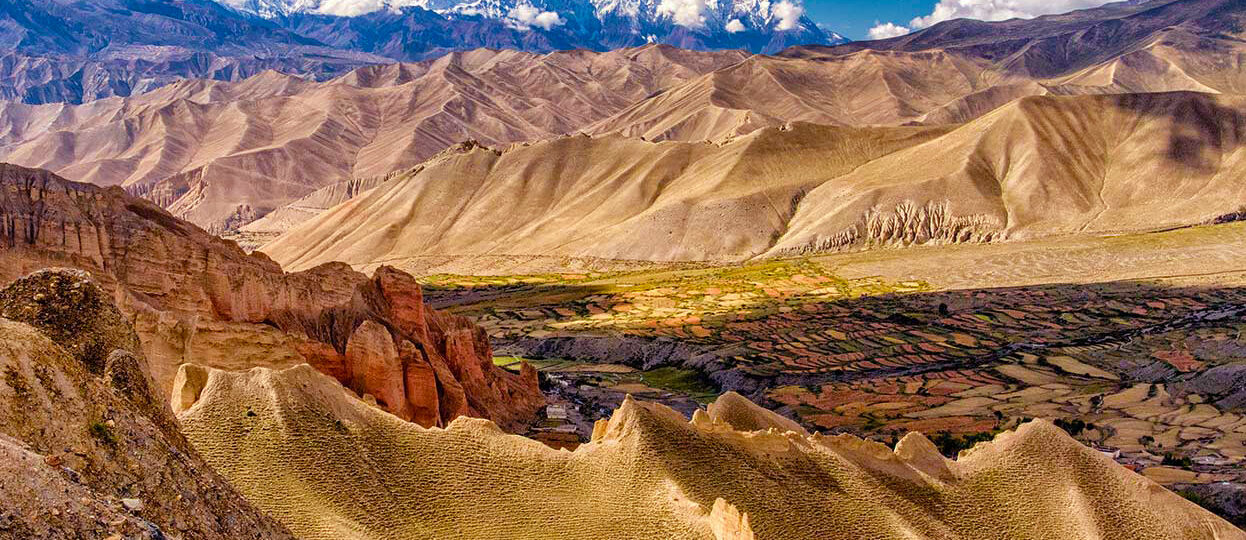
Upper Mustang is located at the northern border of Nepal with China. It is known as mini Tibet as per the geography and living style of the Local people. It is the rain shadow area of Nepal, Which falls under this region of the Tibetian plateau. Mustang lies on the elevation from 2800 m to 6500 m sea level. It is divided into two parts Upper mustang and lower mustang. It is an ideal destination for the visitor to do upper mustang trek.
Climate in Mustang
It is a rain shadow area, a climate of upper mustang like desert climate. The temperature of Upper Mustang has been rising at a higher compared to the other regions of Nepal. The constant wind (causes because of the low air pressure of Tibetian pleatue ), low rainfall along with intense sunshine makes this Trans Himalayan zone very harsh, arid, and rugged.

People, language, and culture of Mustang
People of Upper mustang are called “Lowa”.Where Lo- means the north in the Tibetan language and “Lowa” refers to the people who live in the north of Tibet. So that upper will be referred to as “Lo”. The language spoken by the people of their region is called “loba”, Loba is a dialectical version of Tibetan language. These allow people to practice Tibetan Buddhism culture.
The culture of the lower mustang is more attuned to Tamang. Tamang is considered the largest Tibeto-Burman ethnic group in Nepal. The majority of people who live in the lower belt are Thakalis. Lower mustang Originate from “Thak Kohla” region Which is the series of valleys from the river Kali Gandaki. The language spoken by the thakali people is more similar to Tamang people but totally different from Loba language. Thakali people practices both Hindu and Buddhist culture. Thakali people practice both Hinduism and Buddhism. The major festival of upper mustang is tiji this festival is celebrated for 3 days it falls in the month of May. Many international traveller are willing to see upper mustang with tiji fastival.
It is said that the local King has taken a certain degree of internal autonomy and whole power is vested mostly in the Upper Mustang region. This could be attributed to the socio-cultural history of the origin in this region. As a difference in the culture, there always seems to be a legal distinction between Upper Mustang and Lower Mustang.
People engaged in UpperMustang
People of Upper mustang mostly subsites three occupations: agriculture, animal husbandry, and trans-Himalayan trade. But due to the causes of low annual rainfall, low temperature, and single growing season the productivity of agriculture is low. Moreover, limited agricultural products are grown which are Buckwheat, Barley, and wheat. Whereas some vegetable farming like potatoes and radish also be grown in this region. Whereas rice was considered a luxury that only rich people could afford because it was imported from the hilly region. rice was considered to be a luxury and only a few rich people could afford it because rice has to be imported from the hilly region of Nepal.
Animal husbandry is not taken as sensitive as agriculture in Upper Mustang. Environmental constraints and the limited area of land is an easier opportunities for animal Husbandry. People in this region raise goats, sheep, and yaks. There is a long tradition of trading salt, animals, and other commodities from Tibet.
Tourism in Upper Mustang
Upper Mustang is known as “The Forbidden Kingdom” and Lomanthang. Lomangthang is the historical capital of “The Ancient Walled City”. Now in recent days, upper mustang trek is a popular destination for foreigners and for Domestic tourists. The exquisite landscape a long with its unique culture makes it an attraction for tourists. It is only the place where pure Tibetian culture exists today in Nepal which also is a major attraction for tourism.
It is believed that the 14th Dalai Lama, who is the spiritual and religious leader of Tibet in exile, said, “If you want to know what Tibet was like before the invasion of China, go to Lo”. Untouched temples, lo mangthang monasteries, shrines, and sky caves are situated there where monks used to meditate centuries ago.
Till 1992 This region was totally isolated from the rest of the world. Foreigners were allowed to enter this district but only the boundary between lower and upper. Whereas upper mustang is totally isolated from the rest of the world. Finally, In March 1992, Upper was officially opened to foreigners. Where the tourists interested to visit upper mustang required a special Restricted area permit before they enter. It generates more revenue for local people through tourism activities. For the initial first 10 days permit is $500 per person on 2 person compulsory. If the tourist wants to stay beyond 10 days they have to pay $10 for each day. Not only that fee but the visitors just need to pay the Annapurna conservation area fee which is around $50 for tourists. But the number of tourists is limited which is allowed to visit only 1000 annually.
The following rules are set by the ACAP for those who visit Upper mustang:
1) You must have an entry permit from the department of immigration in Kathmandu.
2) A licensed trekking guide must be a requirement for the tourist.
3) Minimum two number of tourists are needed excluding the guide.
4)Check in every post and show their permit along with the valid identification which must need to match with the permits.
5) Campfire is restricted in Upper mustang.
6) For refining the waste what you bring needs to be back with you.
7) Disturb, hurt, and remove wildlife and plants are not allowed.
Acap also provides some codes of conduct for the tourist who visiting upper mustang, they are:
1) Choose those lodges/hotels that use alternatives to wood for cooking to save fuel.
2) Use safe drinking water or purify yours then buy a bottled one.
3) Use toilets if possible, if in wild go far away about 150m from the water sources.
4) Not buy the products made from wildlife products.
5) Must adopt local customs whenever and wherever possible.
6) Respect privacy, so always ask for permission before taking pictures of people or religious
sites.
7) You have asked for permission before entering houses uninvited.
8) Leave the antiques where they belong.
9) Begging and encouraging fair dealing need to discourage.