Festival in Kathmandu valley: Indra Jatra
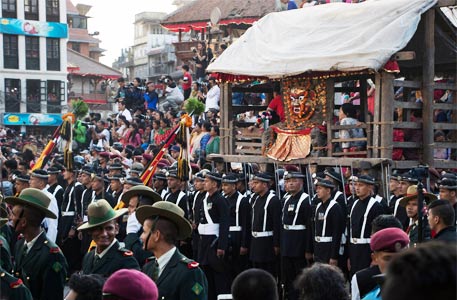
Indra Jatra is the biggest religious street festival in Nepal. This festival is known as yenya by the local people of Kathmandu. Yen translates to Kathmandu and ya means celebration. The two main celebration falls during yenya. The first one is KumariJatra. KumariJatra lasts for three days and three chariots representing three deities are pull to different festive routes of Kathmandu each day. The chariots of goddess Kumari, lord Ganesh and lord Bhairava are pulled by groups of people and accompanied by musical bands during the march. The other celebration is called Indra Jatra. Indrais the name of lord of heaven and lord of rain in Hindu mythology. people celebrate this festival with a wish of enough rain for the year. Mostly local farmers have been involved in this festival for centuries. Indra Jatra usually last for 7-8 days but then you will see the spectacle on the beginning days of Indra Jatra.it usually falls on the last day of summer on the night of full moon. Crowds from different communities as well as foreigners gathered in front of Kathmandu durbar square area to observe the celebration. The president or prime minister attends the festival with the other foreign dignitaries each year.
History and tales:
This celebration was started by by king Gunakamadeva, founder of the city of Kathmandu in 723 AD. He started this festival in the remembrance of founding of the Kathmandu valley. This festival was celebrate with the same authenticity since then. There are many folk tales relating to this festival. The famous one among them is about lord Indra. Lord Indra came down to earth from heaven in search of parijat (night Jasmin) for his mother. He was caught stealing the flower from garden and bound like a common thief. His mother worried about his late return came to Kathmandu and wander around the valley.
After people found out that they have bound the lord Indra himself, they were horrified about that fact and immediately released him. Out of appreciation of Indra’s release his mother promised to provide enough dew throughout the winter so that the crops will grow properly. It is believed that after that time Kathmandu start to have a misty mornings in the winter.
Highlights of the festival
Towering of lingo:
lingo is a ceremonial pole selected to be erect and worshiped during different festivals in Nepal. it is chosen from the straight trees found in kavre of Nepal. The tree is cut down, branches cut off, and stripped of its bark. The towering lingo marks the start of the Indra Jatra festivals. People use thick ropes to erect the 36-foot wooden pole. The banner of lord Indra is placed on the top of the pole, showing that it is the land of lord Indra.
Lighting incense sticks:
the people who have lost loved ones in the past year the incense sticks are burn at various temples around the Kathmandu valley. This ritual is to pay respect to the decease one so that others can wholeheartedly involve in the celebrations to come.
Unveiling of the Sweta Bhairava in Kathmandu Durbar square:
Bhairava is the more terrifying form of lord Shiva. It is build to protect the city from all the threats. The huge mask of Bhairava is keep behind wooden windows throughout whole year. In the evening traditional Nepalis liquors and rice beer is distribute to the public through the pipe while crowd of men
Kumari Jatra
Kumari Jatra was the traditional practice around 1756 AD.it was started by king Jaya Prakash Malla. This Jatra starts on the third day of the Indra Jatra. The head of the country visits the Kumari and receives a blessing for their rule. They bow before the living goddess and receive tika from her hand. The chariots of Ganesh, Bhairava and Kumari is pulled by men to different parts of Kathmandu.
The march is accompanied by traditional music bands and dances. The march usually starts at 3 pm. on the first day of KumariJatra, the chariots are pulled to the downtown area following the route starting from Basantapur, Maru, lagan, Wonde, Kohity, Bhimsenthan and return to Basantapur. on the second day of the Jatra the chariots are pull through the uptown area following the route starting from Basantapur,Pyaphal, Nyata, Tengal, Asan, Indrachwok,Makhan and returned to Bansantapur. On the third day the chariots are pull through mid-town areas following the routes starting from Basantapur,Pyapal, Yatkha, Nyata, Kilgal, Indrachwok, Makhan and returned to Basantapur.
Masked dance
Different traditional dances performed by the possess men wearing colorful clothes is the most interesting activity of Indra Jatra. Some of the masked dances are performed by certain communities or neighborhoods.
Pulukisi (elephant) dance
This dance is performed by the residents of kilagal tole. They create straw woven and wooden masked elephant representing it as the ride of lord Indras. It is carried in the streets of Kathmandu enacting the search of the Indras elephant during his imprisonment. People cheer and dance while carrying the elephant and are usually accompanied by a musical band. A person runs in front carrying a torch. Elephant runs through the streets knocking anyone on its path.
Lakhey dance
Lakhey a man-eating demon wears a huge red mask with scary big eyes, sticked out fangs, jagged teeth, and a dark wig. People believe that the spirit of Lakhey resides within the mask of Lakhey. as a dancer puts on the mask he is possesse by the spirit of Lakhey and his movement is controlled by the demon. The Lakhey starts to dance while intimidating the people all around him. Lakhey dance has a swift movement of hands while running to the beat of the music. Lakhey pushes anyone on its path while crowd follows him with fascination.
The lingo erect on the first day is down on the last day of Indra Jatra. The Indras flag (Indradhwaj) is floating away in Bagmati river. This marks the end of the Indra Jatra festival. Indra Jatra brings people from all over the country from different cultures and communities. Not only Newars of Kathmandu but the other people outside the valley gather together to see the festival. There is no restriction toward any community or religion to observe the festival. It is an amazing experience to be in durbar square during the festival of Indra Jatra. Indra Jatra also marks the starting of the two biggest festivals of Nepal, Dashain and Tihar. If you are planning your trip to Nepal around September or October you can consider making a plan accordingly. For any more information on Nepalese culture and Nepal travel, you can contact us at Redcarpet Journey.