“In the footsteps of the Buddha, through the misty valleys of Nepal, where every stone whispers dharma and every mountain peak reaches toward enlightenment.”
Introduction: The Spiritual Call of Nepal
The morning mist clings to the sacred stupas of Swayambhunath as the first rays of sunlight pierce through the Kathmandu Valley, illuminating prayer flags that flutter like colorful mantras in the gentle breeze. Below, pilgrims begin their clockwise circumambulation, their soft chants mixing with the distant sound of temple bells—a timeless symphony that has echoed through these mountains for over 2,500 years.
As I stand among these devoted souls, breathing in the fragrant incense that rises from countless butter lamps, I am reminded of the profound words of the Buddha himself: “There are, O monks, four places on earth which a believing householder’s son or a believing householder’s daughter should commemorate as long as they live”. Among these four sacred sites, one lies nestled in the very heart of Nepal—Lumbini, the birthplace of Prince Siddhartha, who would become the Buddha and transform the spiritual landscape of humanity forever.
My journey to Nepal began not merely as a quest for knowledge, but as a spiritual pilgrimage. Having spent decades studying Buddhist texts and visiting sacred sites across Asia, I was drawn to this Himalayan nation not just because it is the birthplace of the Buddha, but because it represents the living embodiment of Buddhist heritage. Here, ancient traditions flourish alongside modern devotion, where Newar Buddhist artisans continue to craft intricate mandalas and prayer wheels as their ancestors did centuries ago, and where Tibetan refugees have created vibrant spiritual communities that keep the dharma alive.
Nepal’s significance in the Buddhist world extends far beyond its role as the birthplace of the Buddha. It is a living museum of Buddhist culture, a place where the teachings of the Enlightened One have been preserved, practiced, and passed down through generations. The country is home to some of the world’s most important Buddhist manuscripts, which were saved from destruction by dedicated Newar communities that recognized their immense cultural and historical value. From the ancient stupas of Swayambhunath and Boudhanath to the sacred caves of Pharping where Guru Rinpoche attained enlightenment, Nepal offers a complete spiritual journey through the evolution of Buddhist thought and practice.
This pilgrimage will take us through five transformative locations: Lumbini, where the Buddha first drew breath; Swayambhunath, the self-arising stupa that has watched over the Kathmandu Valley for millennia; Boudhanath, the great mandala that serves as the heart of Tibetan Buddhism in Nepal; Namobuddha, where compassion was demonstrated in its purest form; and Pharping, where tantric Buddhism found its ultimate expression. Each site offers not only historical significance but also a living connection to the teachings that have guided millions toward enlightenment.
Detailed Exploration of Sacred Buddhist Sites
Lumbini: The Sacred Garden of Birth

The journey to Lumbini begins before dawn, as the first light reveals the flat plains of the Terai region, where the Himalayas meet the fertile lowlands of Nepal. Here, in this seemingly simple landscape, one of history’s most significant events occurred—the birth of Prince Siddhartha Gautama in 563 BCE.
As Queen Maya Devi traveled to her ancestral home in Devadaha, she stopped in the beautiful gardens of Lumbini, drawn by the shade of a magnificent sal tree. According to Buddhist tradition, she grasped the tree’s branch and, in a moment of profound serenity, gave birth to the child who would become the Buddha. Legend tells us that the newborn prince immediately took seven steps, each marked by a blooming lotus flower, and declared: “I am the chief in the world. There is no equal to me. I am supreme. This is my last birth. No Rebirth for me”.
The Maya Devi Temple stands at the exact spot of this miraculous birth, its modern structure protecting ancient ruins that archaeologists have dated to the 3rd century BCE. Excavations in 2013 revealed timber structures that may date back to 1000 BCE, suggesting that this site has been venerated for millennia. The temple houses a remarkable sandstone relief depicting the birth scene, carved in the 4th century CE, showing Queen Maya grasping the sal tree branch while the infant Buddha emerges from her right side.
The Ashoka Pillar, erected by Emperor Ashoka in 249 BCE, stands as one of the most significant archaeological sites associated with the Buddha’s birthplace. The inscription in ancient Brahmi script declares: “When King Devanampriya Priyadarsin had been anointed for twenty years, he came himself and worshipped (this spot) because the Buddha Shakyamuni was born here”. This pillar, weathered by centuries but still standing proud, serves as a tangible link between the present and the moment when one of history’s most extraordinary emperors paid homage to the Buddha’s birthplace.
The sacred Puskarini Pond, where Queen Maya bathed before giving birth and where the infant Buddha received his first ritual bath, remains a place of profound reverence. Pilgrims from around the world come to its peaceful shores, some to meditate, others to perform ritual ablutions, all seeking to connect with the spiritual energy that permeates this place.
Walking through the monastic zone, one encounters a remarkable display of international devotion. Over twenty-five monasteries, built by countries from Vietnam to Germany, each reflecting their unique architectural traditions while maintaining the universal Buddhist principles of peace and compassion. The World Peace Pagoda, constructed by Japanese Buddhists, rises majestically above the sacred garden, its golden spire catching the light like a beacon of hope.
The atmosphere in Lumbini is one of profound tranquility. The morning chanting of monks blends with the gentle rustling of prayer flags, creating a soundscape that seems to transport visitors back to the time of the Buddha. The sacred garden itself, with its ancient trees and peaceful pathways, invites contemplation and reflection. It is here that one truly understands why the Buddha chose this spot for his final incarnation—there is something inherently peaceful about this place that speaks to the soul.
Swayambhunath: The Self-Arising Wisdom
Perched majestically on a hilltop overlooking the Kathmandu Valley, Swayambhunath Stupa—affectionately known as the Monkey Temple—represents one of Nepal’s most ancient and revered Buddhist sites. The name “Swayambhunath” translates to “self-arisen” or “self-existent,” reflecting the sacred legend that this stupa manifested spontaneously from a lotus flower that bloomed in the primordial lake that once covered the Kathmandu Valley.
The ascent to Swayambhunath is a spiritual journey in its own right. The 365 stone steps, each representing a day of the year, wind up the eastern side of the hill, passing smaller shrines and vendors selling prayer flags and offerings. The climb is both physical and metaphorical—with each step, one leaves behind the mundane world and enters the realm of the sacred. The resident monkeys, considered holy and believed to be the reincarnated lice of the Bodhisattva Manjushri, playfully observe pilgrims as they make their ascent.
At the summit, the great stupa dominates the landscape, its white dome representing the earth element and its golden spire symbolizing the Buddha’s enlightenment. The most striking feature is the pair of Buddha’s eyes painted on all four sides of the stupa’s harmika, gazing out over the valley with serene compassion. Between the eyes, the Nepali number one (resembling a nose) represents the unity of all existence, while the third eye above signifies the Buddha’s wisdom that sees beyond ordinary perception.
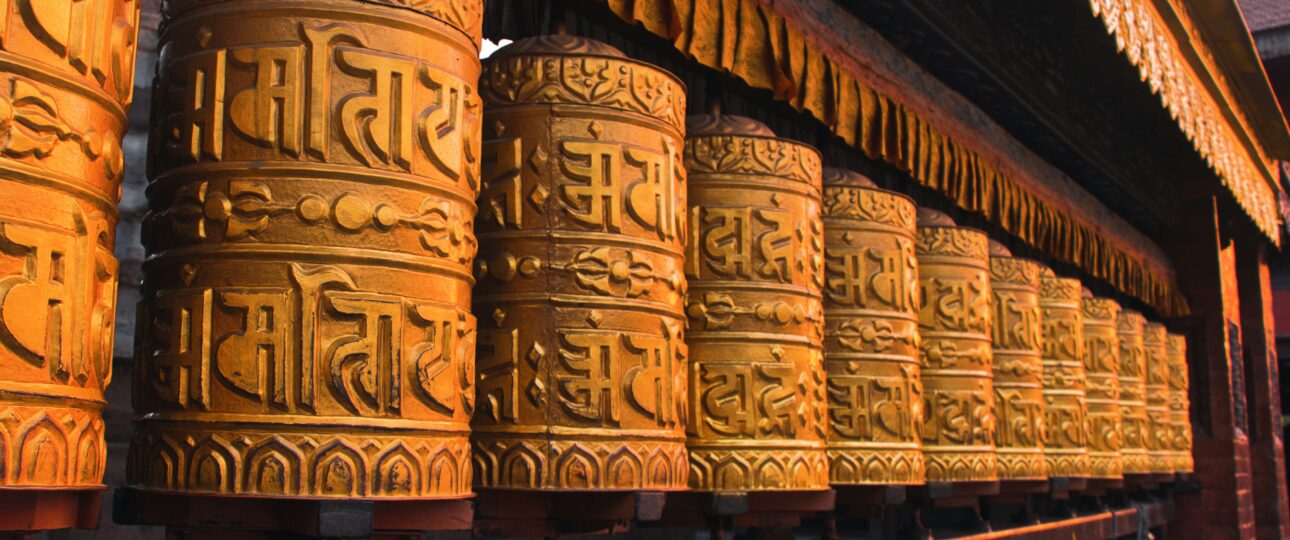
The stupa complex is a living mandala, with shrines dedicated to the five elements—earth, water, fire, air, and space—positioned at the cardinal points. Prayer wheels line the base, each revolution carrying mantras and prayers skyward. The sound of spinning wheels, combined with the gentle chanting of pilgrims as they make their clockwise circumambulation, creates a meditative atmosphere that has remained unchanged for centuries.
The panoramic view from Swayambhunath is breathtaking. The entire Kathmandu Valley spreads out below, with the ancient cities of Kathmandu, Patan, and Bhaktapur visible in the distance. On clear days, the snow-capped peaks of the Himalayas form a spectacular backdrop, reminding visitors of the vast spiritual landscape that surrounds this sacred site.
What makes Swayambhunath particularly special is its role as a place of religious harmony. While fundamentally Buddhist, the site also houses Hindu shrines, reflecting the syncretic nature of Nepali spirituality. The temple to Harati, the protector of children, draws both Buddhist and Hindu devotees, while the sleeping Buddha statue on the western side provides a serene spot for quiet contemplation.
The spiritual energy at Swayambhunath is palpable. Whether it’s the elderly Tibetan woman spinning prayer wheels with unwavering devotion, the young monk quietly studying Buddhist texts in the morning sun, or the Western pilgrim sitting in meditation facing the valley, the site serves as a bridge between different cultures and traditions, all united in their quest for enlightenment.
Boudhanath: The Great Mandala of Compassion
Boudhanath Stupa rises from the eastern edge of Kathmandu like a massive mandala made manifest in stone and mortar. This UNESCO World Heritage Site, one of the largest stupas in the world, serves as the spiritual heart of Tibetan Buddhism in Nepal and stands as a powerful symbol of Buddhist cosmology.
The stupa’s architecture is rich in symbolism. The massive white dome, representing the Earth element, houses sacred relics of the Buddha, including authentic bone fragments of both the Kassapa Buddha and the Shakyamuni Buddha. The thirteen-tiered golden spire above represents the stages of enlightenment, while the Buddha’s eyes, painted on all four sides of the harmika, watch over the faithful with infinite compassion.
The origins of Boudhanath stretch back to the 5th century CE, when King Manadeva built it as a symbol of the Buddha’s enlightenment. Legend tells that the stupa was constructed on the spot where a sacred relic of the Buddha was discovered, making it a potent pilgrimage site. The structure has been rebuilt and renovated numerous times, most recently after the devastating 2015 earthquake that damaged its spire.
The arrival of Tibetan refugees following the 1959 uprising transformed Boudhanath into a vibrant center of Tibetan culture. Over fifty monasteries and meditation centers now surround the stupa, creating a “Little Tibet” in the heart of Nepal. The sound of Tibetan chanting, the sight of crimson-robed monks, and the aroma of juniper incense create an atmosphere that transports visitors to the high plateaus of Tibet.
The daily rhythm of Boudhanath revolves around the practice of kora—circumambulation of the stupa. From dawn to dusk, pilgrims walk clockwise around the massive structure, spinning prayer wheels and chanting mantras. The most popular mantra, “Om Mani Padme Hum,” can be heard throughout the day, creating a constant backdrop of spiritual energy. Prayer flags strung from the stupa’s pinnacle flutter in the breeze, carrying prayers and mantras toward the heavens.
The devotional practices at Boudhanath are profoundly moving. Elderly Tibetan women, their faces weathered by years of hardship, prostrate themselves before the stupa while whispering prayers for all sentient beings. Young monks debate philosophical points in the monastery courtyards, their animated discussions reflecting the living tradition of Buddhist scholarship. Western practitioners sit in meditation, finding peace in the stupa’s powerful presence.
The surrounding area pulses with Tibetan life. Traditional thangka painters work in small studios, creating intricate religious art that preserves ancient techniques. Shops sell prayer wheels, singing bowls, and ritual objects crafted by skilled artisans. Restaurants serve traditional Tibetan cuisine, from momos (dumplings) to butter tea, creating a complete cultural experience.
The evening hours at Boudhanath are particularly magical. As the sun sets, butter lamps are lit throughout the complex, creating a warm glow that illuminates the stupa’s white dome. The sound of horns and drums from evening prayers drifts across the plaza, while the last circumambulators complete their devotional walks. In these moments, one can truly feel the presence of the sacred, the sense that this place serves as a bridge between the earthly and the divine.
Namobuddha: The Hill of Compassion
Forty kilometers southeast of Kathmandu, the sacred hill of Namobuddha rises from the pastoral landscape of the Kavre district, crowned by an ancient stupa that commemorates one of the most profound acts of compassion in Buddhist literature. This site, considered one of the three most essential stupas in the Kathmandu Valley alongside Swayambhunath and Boudhanath, offers pilgrims a deeply moving encounter with the Buddhist ideals of selfless love and sacrifice.
The legend of Namobuddha centers on Prince Mahasattva, a previous incarnation of the Buddha, who, while hunting in the forest with his two brothers, encountered a starving tigress and her newborn cubs. Moved by overwhelming compassion, the prince realized that the tigress was too weak to hunt for food and would die along with her cubs. In the ultimate act of selfless love, he offered his own body to nourish the tigress, demonstrating the Buddhist principle that no sacrifice is too great when motivated by genuine compassion for all sentient beings.
The stupa that marks this sacred site contains the bone relics of Prince Mahasattva, making it a powerful destination for pilgrimage. The structure itself is elegant in its simplicity—a white dome topped by a golden spire, surrounded by prayer flags that flutter in the mountain breeze. The circumambulation path around the stupa is worn smooth by countless pilgrims who have come here to contemplate the meaning of genuine compassion.
The approach to Namobuddha is as spiritually significant as the destination itself. The three-hour trek from Dhulikhel or Panauti winds through terraced fields, traditional villages, and rhododendron forests, offering glimpses of rural Nepali life that remain essentially unchanged from the Buddha’s time. The journey allows for gradual spiritual preparation, with each step bringing pilgrims closer to the profound energy of the sacred site.
The Thrangu Tashi Yangtse Monastery, founded by the renowned Tibetan master Thrangu Rinpoche, is situated adjacent to the stupa and serves as a center for Buddhist learning and meditation. The monastery’s golden roofs and red walls create a striking contrast against the green hills, while the sound of chanting and the sight of young monks studying in the courtyards add to the site’s spiritual atmosphere.
The tigress cave, located up the hill from the main stupa, marks the actual spot where the sacrifice took place. A statue within the cave depicts the moment of Prince Mahasattva’s self-offering, serving as a powerful reminder of the lengths to which a bodhisattva will go to alleviate the suffering of others. The cave itself is a place of profound meditation, where visitors can contemplate the nature of compassion and selflessness.
The panoramic views from Namobuddha are breathtaking. The Himalayan peaks stretch across the northern horizon, while the valleys below are dotted with traditional villages and ancient temples. This natural beauty enhances the spiritual experience, creating a sense of connection between the earthly and the transcendent that is central to Buddhist understanding.
The annual Namobuddha Mela festival, held in November, attracts thousands of pilgrims to the site. The celebration features traditional dances, religious ceremonies, and teachings by renowned Buddhist masters, fostering a vibrant atmosphere of devotion and learning. During this time, the entire hill becomes a temporary monastery, with pilgrims camping under the stars and participating in continuous prayer and meditation.
Pharping: The Tantric Gateway
In the hills southwest of Kathmandu, the small village of Pharping holds a secret that has drawn tantric practitioners for over a millennium. Here, in sacred caves carved into the mountainside, Guru Padmasambhava—known as Guru Rinpoche—achieved the ultimate realization of Mahamudra, making this site the most important pilgrimage destination for practitioners of Vajrayana Buddhism outside of Tibet.
The legend of Pharping begins with Guru Rinpoche’s intensive retreat in two caves: the upper Asura Cave and the lower Yangleshö Cave. During the winter months, he practiced in the sunny upper cave, while in the summer, he retreated to the cooler lower cave. Through combining the practices of Yangdak Heruka and Vajrakilaya—two of the most powerful tantric deities—he attained the siddhi of Mahamudra, the Great Seal of enlightenment.
The Asura Cave, reached by a steep climb through dense forest, remains essentially unchanged from Guru Rinpoche’s time. The cave entrance bears a handprint believed to be left by the master himself, and pilgrims often press their own hands against it, seeking a direct connection with his realization. Inside, the cave is adorned with butter lamps, prayer scarves, and ritual objects left by devoted practitioners. The atmosphere is thick with incense and the accumulated prayers of centuries of pilgrims.
The Yangleshö Cave, more accessible and located near the village, houses several essential shrines. The cave where Guru Rinpoche meditated is small and intimate, creating a sense of direct connection with the master’s practice. Adjacent to the cave is a small retreat monastery, Rigdzin Drubpe Gatsal Ling, where contemporary practitioners continue the tantric traditions in the exact location where they were perfected.
The Vajrayogini Temple, situated between the two caves, is one of the most significant tantric sites in the Nepalese mandala. Dedicated to the fierce female deity Vajrayogini, the temple is a center for advanced tantric practices. The temple’s architecture reflects the complex symbolism of Vajrayana Buddhism, with intricate carvings and statues that serve as meditation supports for practitioners.
The spiritual energy at Pharping is distinctly different from other Buddhist sites. Where places like Lumbini inspire peace and Boudhanath encourage devotion, Pharping pulses with the raw power of tantric realization. The combination of the natural setting—dense forests, sacred caves, and mountain streams—with the accumulated spiritual energy of centuries of practice creates an environment that is both beautiful and intense.
Modern Pharping has become a hub for Tibetan Buddhist monasteries and retreat centers. The large statue of Guru Rinpoche, still under construction and funded by international donations, will eventually tower 100 feet above the valley, serving as a beacon for practitioners worldwide. The presence of numerous accomplished masters and the ongoing construction of retreat facilities ensures that Pharping remains a living center of tantric practice.
The village itself reflects the syncretic nature of Nepali spirituality. While primarily Buddhist, Pharping also houses important Hindu sites, including the nearby Dakshinkali Temple dedicated to the goddess Kali. This religious diversity mirrors the tantric understanding that all phenomena are expressions of the same underlying reality, whether approached through Buddhist or Hindu methods.
For serious practitioners, Pharping offers retreat facilities and teachings that are difficult to find elsewhere. The combination of sacred geography, authentic lineage holders, and the blessing of Guru Rinpoche’s realization creates ideal conditions for tantric practice. Many Western practitioners have found that time spent at Pharping dramatically deepens their understanding of Vajrayana Buddhism and their personal practice.
Cultural and Spiritual Insights
The Living Tradition of Buddhist Rituals
The Buddhist practices witnessed throughout Nepal reveal a living tradition that has evolved over centuries while maintaining its essential spiritual core. In the early morning hours at Boudhanath, elderly Tibetan women begin their daily circumambulation, their prayer wheels spinning rhythmically as they chant “Om Mani Padme Hum” with devotion that has remained unchanged for generations. This practice, known as kora, represents far more than simple walking—it is a moving meditation that aligns body, speech, and mind with the Buddha’s teachings.
The ritual of prostration, observed at all major Buddhist sites, demonstrates the depth of devotion that characterizes Nepali Buddhism. Pilgrims approach stupas with their hands pressed together in prayer, then lower themselves to the ground in a gesture of complete surrender to the Three Jewels—Buddha, Dharma, and Sangha. At Swayambhunath, I witnessed a young Tibetan monk performing a full prostration at each of the four cardinal directions, his movements precise and mindful, each gesture carrying the weight of centuries of tradition.
Offering butter lamps represents one of the most beautiful and meaningful Buddhist practices. At Lumbini’s Maya Devi Temple, thousands of small clay lamps flicker throughout the day, each one lit by a pilgrim making a wish for the benefit of all sentient beings. The warm glow of these lamps creates an atmosphere of sacred intimacy, while the act of lighting them represents the illumination of wisdom, dispelling the darkness of ignorance.
Prayer flags, strung between trees and buildings at every sacred site, serve as a constant reminder of the Buddhist aspiration for universal liberation. These colorful rectangles of cloth, printed with mantras and prayers, flutter in the wind, carrying their sacred messages to all corners of the world. The five colors—blue for sky, white for air, red for fire, green for water, and yellow for earth—represent the five elements and the interconnectedness of all existence.
Festival Celebrations and Community Gatherings
The Buddhist festival calendar in Nepal reflects the deep integration of spiritual practice with daily life. Buddha Jayanti, celebrating the birth, enlightenment, and death of the Buddha, transforms every Buddhist site into a center of celebration. At Lumbini, pilgrims arrive from around the world to participate in special ceremonies at the exact spot where the Buddha was born. Meanwhile, at Swayambhunath and Boudhanath, the festivities continue throughout the night with continuous chanting and prayers.
The Tibetan New Year, Losar, brings a different energy to Nepal’s Buddhist communities. The celebrations last for fifteen days, with the first three days featuring elaborate ceremonies, traditional dances, and the sharing of special foods, such as changkol, a festive drink made from Tibetan chang beer. The monasteries become centers of community gathering, where families come together to receive blessings and participate in ritual offerings.
The Mani Rimdu festival, celebrated in the high monasteries of the Everest region, represents one of the most spectacular Buddhist celebrations in Nepal. The masked dances performed by monks tell the story of Buddhism’s victory over the dark forces of ignorance, while the elaborate costumes and music create a multi-sensory experience that transports participants into the realm of tantric symbolism.
Philosophical Teachings and Daily Practice
The Buddhist sites of Nepal serve as living classrooms where ancient teachings are transmitted through direct experience. At Kopan Monastery, international students gather for intensive courses in Buddhist philosophy, studying the “Graded Path to Enlightenment” that forms the foundation of Tibetan Buddhist practice. The monastery’s approach combines intellectual study with meditation practice, creating a comprehensive understanding of the Buddha’s teachings.
The tradition of debate, witnessed in the courtyards of many Tibetan monasteries, represents a unique method of deepening understanding. Young monks engage in animated discussions about philosophical points, their clapping and gesturing creating a rhythmic accompaniment to the examination of complex topics, such as emptiness, compassion, and the nature of reality.
The practice of meditation, whether in the silent halls of Vipassana centers or the chanting chambers of Tibetan monasteries, remains central to Buddhist practice in Nepal. The Nepal Vipassana Center offers ten-day silent retreats where practitioners learn the ancient technique of mindfulness meditation. In contrast, Tibetan centers like Benchen Monastery provide instruction in visualization practices and mantra recitation.
Encounters with Spiritual Teachers
Throughout my journey, encounters with Buddhist teachers—both monastic and lay—provided profound insights into the living tradition of Nepali Buddhism. At Namobuddha, I met Ani Pema, a Western nun who had spent twenty years in retreat studying under Tibetan masters. Her explanation of the site’s significance went beyond historical facts to reveal the more profound spiritual implications of Prince Mahasattva’s sacrifice: “True compassion,” she explained, “is not just feeling sorry for others’ suffering, but being willing to take on that suffering ourselves to alleviate it.”
At Pharping, I encountered Lama Tenzin, a Tibetan master who had studied the tantric practices associated with the sacred caves. His teaching emphasized the importance of place in spiritual practice: “These caves are not just historical sites,” he said, “they are doorways to the same realization that Guru Rinpoche achieved. When we practice here, we connect directly with his mind stream and the unbroken lineage of transmission.”
The wisdom of these teachers, combined with the sacred environment of Nepal’s Buddhist sites, creates ideal conditions for spiritual transformation. Their teachings, rooted in centuries of practice yet relevant to contemporary seekers, demonstrate the timeless nature of the Buddha’s message and its continued relevance for modern practitioners.
Practical Travel Guidance
Optimal Timing for Sacred Journeys
The timing of your Buddhist pilgrimage to Nepal can significantly enhance your spiritual experience. The optimal periods are during spring (March to May) and autumn (September to November), when clear skies and moderate temperatures create ideal conditions for both outdoor activities and contemplative practice.
Spring brings the added blessing of rhododendrons in bloom, Nepal’s national flower, creating a spectacular natural backdrop for your spiritual journey. The weather during these months ranges from 10°C to 25°C (50°F to 77°F), perfect for the long walks and meditation sessions that form the heart of Buddhist pilgrimage. This season also coincides with Buddha Jayanti, the most significant Buddhist festival, providing pilgrims with the opportunity to participate in memorable ceremonies and celebrations.
Autumn provides perhaps the most spiritually enriching experience, with the post-monsoon clarity offering unobstructed views of the Himalayas from sites like Namobuddha and Swayambhunath. The moderate temperatures, ranging from 10°C to 20°C (50°F to 68°F), create comfortable conditions for extended periods of meditation and contemplation. This season also coincides with major Nepali festivals, such as Dashain and Tihar, providing insight into the cultural context of Buddhist practice.
The monsoon season (June to August) should generally be avoided, as heavy rains can disrupt travel and make outdoor pilgrimage activities challenging. However, for those seeking solitude and willing to embrace the inconveniences, the monsoon can offer a more intimate experience with fewer crowds and a dramatically different landscape.
Transportation and Accommodation
Navigating Nepal’s Buddhist sites requires careful planning, especially for international pilgrims. Kathmandu serves as the primary hub, with Tribhuvan International Airport providing connections to major cities worldwide. From Kathmandu, the main options for reaching pilgrimage sites are domestic flights to Bhairahawa (for Lumbini) or overland travel by bus or private vehicle.
For Lumbini, the most significant pilgrimage destination, various transportation options are available. A domestic flight from Kathmandu to Bhairahawa, followed by a short drive to Lumbini, offers the fastest route. In contrast, the overland journey by bus or private vehicle takes approximately 7-8 hours but provides scenic views of Nepal’s diverse landscapes.
The sites within the Kathmandu Valley—Swayambhunath, Boudhanath, and nearby Pharping—are easily accessible by taxi or local bus. Many pilgrims choose to stay in the Boudhanath area, which offers numerous guesthouses run by Tibetan families, providing an authentic cultural experience alongside comfortable accommodation.
For Namobuddha, the journey from Kathmandu can be combined with a visit to the ancient city of Dhulikhel, with accommodation available in both locations. The three-hour trek from Dhulikhel to Namobuddha offers a traditional pilgrimage experience, while road access makes the site accessible to those unable to walk long distances.
Respectful Conduct and Dress Guidelines
Visiting Buddhist sites in Nepal requires adherence to specific cultural and religious protocols that demonstrate respect for the sacred spaces and the communities that maintain them. The most fundamental requirement is modest dress—both men and women should ensure their shoulders and knees are covered when entering temples and monasteries.
The dress code extends beyond simple coverage to include color and style considerations. Bright, flashy clothing can be distracting in meditation spaces, while overly tight or revealing garments may offend local sensibilities. Traditional Buddhist sites appreciate subdued colors and loose-fitting clothes that allow for comfortable sitting during meditation sessions.
Footwear must be removed before entering most sacred buildings, including temples, monasteries, and shrine rooms. Many sites provide shoe storage areas, but pilgrims should be prepared to walk on potentially rough or cold surfaces. Some sites also prohibit leather items, considering them inappropriate for sacred spaces.
Behavioral etiquette is equally important. Voices should be kept low, and mobile phones should be turned off or set to silent mode in meditation areas. Photography requires special consideration—while many sites allow photography in outdoor areas, permission should always be sought before photographing people or sacred objects.
The practice of walking clockwise around stupas and other sacred structures is fundamental to Buddhist pilgrimage etiquette. This movement pattern, known as circumambulation or kora, mirrors the sun’s movement and symbolizes the path to enlightenment.
Recommended Lesser-Known Sites
Beyond the major pilgrimage destinations, Nepal offers numerous lesser-known Buddhist sites that provide intimate spiritual experiences away from crowds. Tilaurakot, believed to be the site of ancient Kapilavastu, where Buddha spent his youth, offers archaeological ruins and a peaceful atmosphere for contemplation.
The Halesi-Maratika Caves in eastern Nepal represent an essential pilgrimage site for both Buddhists and Hindus, with caves associated with Guru Rinpoche and various meditation masters. The remote location requires more planning but offers a profound experience of sacred geography.
Patan’s Buddhist heritage, often overlooked by visitors focused on the more famous sites, includes numerous ancient monasteries and the Golden Temple (Hiranya Varna Mahavihar), which showcases the sophisticated artistry of Newar Buddhism.
The meditation centers and retreat facilities around Pharping provide opportunities for extended practice in a serene and sacred environment. Places like Neydo Tashi Choling Monastery provide structured retreat programs for serious practitioners.
For those interested in integrating Buddhist practice with natural beauty, the monasteries of the Everest region—accessible via trekking routes—offer a unique experience of high-altitude Buddhist practice among the world’s highest peaks.
Health and Safety Considerations
Buddhist pilgrimage in Nepal requires attention to health and safety considerations, particularly for international visitors. Kathmandu’s altitude of 1,350 meters (4,429 feet) can affect some travelers, while sites like Namobuddha, located at higher elevations, may require gradual acclimatization.
Water quality requires careful attention, with bottled water being recommended for drinking and brushing your teeth. Many monasteries and guesthouses provide filtered water, but pilgrims should verify the source. Food safety follows similar principles, with freshly cooked meals generally safer than raw foods or items that may have been sitting at room temperature.
Travel insurance should include coverage for medical evacuation, as some remote pilgrimage sites are far from modern medical facilities. Basic first aid supplies, including altitude sickness medication for higher elevations, should be included in pilgrimage preparations.
Weather-related safety considerations include protection from both sun and rain, depending on the season. The intense UV radiation at higher altitudes requires appropriate sun protection, while the monsoon season demands waterproof clothing and gear.
Conclusion: A Journey of Transformation
As the sun sets behind the golden spire of Swayambhunath, casting long shadows across the Kathmandu Valley, I find myself profoundly changed by this journey through Nepal’s sacred Buddhist landscape. The pilgrimage that began with academic curiosity has evolved into a deeply personal spiritual transformation, one that has revealed the living essence of the Buddha’s teachings in ways that no amount of textual study could have achieved.
The five sacred sites visited—Lumbini, Swayambhunath, Boudhanath, Namobuddha, and Pharping—each offered unique insights into different aspects of Buddhist practice and realization. In Lumbini, I experienced the profound peace that comes from standing at the very source of Buddhist tradition, where the simple act of breathing in the same space where the Buddha first drew breath creates an immediate connection to 2,500 years of spiritual lineage. The Maya Devi Temple, with its ancient stones and eternal flame, serves as a reminder that enlightenment begins with a single moment of awakening.
Swayambhunath revealed the enduring power of devotion and the importance of elevated perspective, both literally and metaphorically. The climb up the 365 steps becomes a moving meditation, each step representing a gradual release of worldly concerns and an ascent toward spiritual understanding. The panoramic view from the stupa’s base serves as a perfect metaphor for the expanded awareness that comes with Buddhist practice.
Boudhanath demonstrated the power of community and the importance of preserving spiritual traditions in the face of change. The great mandala, with its constant circumambulation of devoted pilgrims, creates a sense of timeless continuity that transcends cultural boundaries. Here, Tibetan refugees and Western seekers, local Newar Buddhists and international pilgrims, all participate in the same ancient practice of walking meditation, united by their shared aspiration for enlightenment.
Namobuddha touched something deep within the heart, revealing the true meaning of compassion through the story of Prince Mahasattva’s ultimate sacrifice. The peaceful hilltop setting, with its simple stupa and profound legend, demonstrates that genuine spiritual realization often comes through the most challenging acts of selflessness. The site serves as a powerful reminder that the path to enlightenment is not just about personal liberation but about the willingness to sacrifice for the benefit of all beings.
Pharping challenged preconceptions about Buddhist practice, revealing the fierce compassion and transformative power of tantric realization. The sacred caves where Guru Rinpoche achieved Mahamudra speak to the possibility of ultimate spiritual achievement through intensive practice and devotion. The site demonstrates that enlightenment is not a gentle, gradual process but can be achieved through the complete commitment represented by retreat practice.
The cultural and spiritual insights gained through encounters with monks, nuns, and lay practitioners revealed that Buddhist practice in Nepal is not a relic of the past but a living, evolving tradition that continues to produce realized beings. From the scholarly debates in monastery courtyards to the quiet devotion of elderly pilgrims spinning prayer wheels, the dharma remains vibrantly alive in Nepal’s Buddhist communities.
The practical aspects of pilgrimage—learning proper etiquette, understanding cultural sensitivities, and developing respectful relationships with local communities—proved to be spiritual practices in their own right. The act of removing shoes before entering temples, walking clockwise around stupas, and maintaining noble silence in meditation halls all serve to cultivate the mindfulness and respect that are fundamental to Buddhist practice.
This journey has revealed that Buddhist pilgrimage in Nepal offers something that cannot be found in books or meditation centers in other countries: direct contact with the unbroken lineage of transmission that stretches back to the Buddha himself. The blessing of these sacred sites, accumulated through centuries of practice and devotion, creates ideal conditions for spiritual transformation.
For those considering their own pilgrimage to Nepal, I offer this encouragement: approach these sacred sites with reverence, openness, and genuine curiosity. Come prepared to be transformed, to have your understanding of Buddhism deepened, and to have your practice refined. The journey will challenge your preconceptions, expand your understanding of devotion, and reveal the profound wisdom that emerges from the marriage of ancient teachings and lived experience.
The Buddha’s words, spoken over two millennia ago, resonate particularly in the context of Nepali pilgrimage: “Better than a thousand hollow words is one word that brings peace.” In Nepal’s sacred sites, surrounded by the devotion of countless pilgrims and the accumulated blessing of centuries of practice, those words that bring peace are not just heard but felt, not just understood but embodied.
The true gift of Buddhist pilgrimage in Nepal is not just the opportunity to visit historical sites, but the chance to participate in a living tradition that continues to guide seekers toward enlightenment. Whether you come as a devoted Buddhist or a curious traveler, whether you seek intellectual understanding or spiritual transformation, Nepal’s Buddhist heritage offers a path toward more profound wisdom and greater compassion.
As you plan your own sacred journey, remember that pilgrimage is not just about reaching destinations but about the transformation that occurs along the way. In the land where the Buddha was born, where his teachings have been preserved and practiced for over two millennia, every step becomes a meditation, every breath a prayer, and every moment an opportunity for awakening.
The call of Nepal’s Buddhist heritage is a call to come home—not to a place, but to the original nature of mind that the Buddha revealed and that continues to shine in the faces of Nepal’s devoted practitioners. Answer that call with courage, curiosity, and an open heart, and you will find that the journey to Nepal becomes a journey to the very heart of Buddhist wisdom.