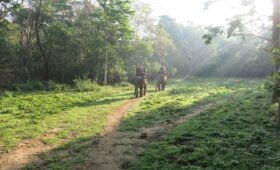
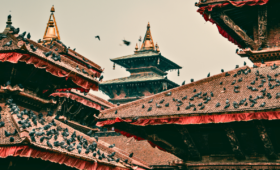
The monsoon transforms Nepal’s valleys into lush emerald landscapes, offering vibrant scenery and solitude. Monsoon Trekking in Nepal during the rainy season (June–September) is a rewarding off-season adventure. Heavy summer rains sweep the lower hills, but the high trails burst with color and greenery. Forests turn greener than ever, hidden waterfalls thunder to life, and rhododendrons and wildflowers bloom along the paths.
With most hikers homebound, trekkers enjoy peaceful trails and misty mountain vistas almost to themselves. Of course, the monsoon has challenges (muddy ground, afternoon downpours, and leeches in damp forests), but these can be managed with good rain gear and insect repellent. This Nepal trekking guide for the rainy season highlights four of the best treks in Nepal during the monsoon—each chosen for its summer-friendly climate—to help adventure-seekers plan a safe, immersive off-season journey.
Trek 1: Upper Mustang Trek

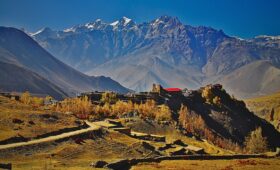
Walking the barren, high-altitude valley of Upper Mustang, where the rain-shadow keeps the terrain dry and clear. Upper Mustang is famed for its rain-shadow climate. This remote northern district lies on the leeward side of the Himalayas, so it receives almost no rain, even during peak monsoon season. Trekkers escaping the downpours head here for desert-like beauty and clear skies.
The Upper Mustang trail (typically 14–16 days) starts from Jomsom (reachable by jeep or flight from Pokhara) and climbs through Kagbeni, Lubra, Charang and finally to Lo Manthang. Along the way, you pass rusty red cliffs, wind-eroded gorges, and ancient Tibetan Buddhist shrines (gompas) carved into cliff faces. The trek’s highlight is Lo Manthang, the old walled capital of the Kingdom of Lo. With its whitewashed royal palace and narrow alleys, Lo Manthang feels like a lost city. Here you can visit age-old gompas (like Thubchen and Jampa) and see Mustang’s king (a cultural figure) or attend the famous Tiji festival (if timing allows).
The desert landscapes and high mani walls give Mustang a mystical feel unlike any other Nepali trek. Logistics are straightforward: Upper Mustang is a teahouse trek, with basic lodges in major villages (Kagbeni, Samar, Ghami, Charang, Lo Manthang). Permits are required: an Annapurna Conservation Area Permit (ACAP) and a Mustang Restricted Area Permit (RAP) must be obtained in Kathmandu. (Nepalese agencies handle these efficiently.) The trail gains altitude gently (highest ~3,810m) and is rated moderate; no glaciers or technical sections are involved, but fine weather gear is essential.
The monsoon season is an excellent time here – skies stay mostly clear, the rivers are low, and no landslides obstruct the path. If trekking in July–August, pack layers (days can be hot, nights cold) and sun protection (UV is high at altitude). Rain can fall in Mustang’s outlying areas, so a light raincoat is wise. Overall, Upper Mustang offers tranquil trails, vibrant Tibetan culture, and reliable, sunny trekking conditions in summer.
Trek 2: Nar Phu Valley Trek
A lone trekker crosses a narrow gorge in the hidden Nar Phu Valley, shaded from monsoon rains. The Nar Phu Valley trek is an off-the-grid route in the Annapurna region, composed of two ancient villages (Nar and Phu) hidden behind high peaks. Like Mustang, Nar Phu lies partially in the rain shadow, so the upper valley stays dry and walkable even during monsoon.
The trail leads through surprisingly lush rhododendron and pine forests at lower levels, then opens into stark canyons and high alpine passes. Because so few hikers come here in summer, trekkers enjoy serenity and remoteness: you might see only a handful of other parties over days. Cultural highlights include the stone-built villages of Meta and Nar Phedi (with its old monastery) and Phu (with its sky-high cliff hamlets).
Meta and Nar’s ruined fortress and gompa evoke an ancient Tibetan frontier, and local people still follow traditional Tibetan Buddhist customs. A typical Nar Phu trek (often looped with part of the Annapurna Circuit) takes 10–16 days, depending on pace. The route goes Besisahar (or Syange) → Koto (Annapurna Circuit junction) → Meta → Nar Phedi → Phu (with acclimatization) → Kang La Pass (5,320m) → descend to Ngawal → Chame → drive to Pokhara.
After crossing Kang La, you rejoin the Annapurna Circuit trail via villages like Ngawal. Nar Phu’s rewards include spectacular Himalayan vistas of Annapurna II, Ganesh Himal, and glaciers on Kang La pass, plus rare wildlife (blue sheep or Himalayan vultures). Because the valley is drier than the surrounding areas, trekkers often note that the ascent above Meta remains surprisingly clean and easy even in summer.
Permits for Nar Phu require both an Annapurna Conservation Area Permit and a special Restricted Area Permit. (Nepal Vision Trek notes ACAP ≈ NPR3,000 and Nar Phu permit roughly USD 75–100 per week.) The trek is rated moderate-to-challenging: the Kang La Pass is high (over 5,300m), so good fitness and acclimatization are essential. Nights are spent in simple tea houses in Koto, Meta, Nar, Phu, and Ngawal (no camping required if you follow the standard route).
Take precautions on muddy or grassy forest sections (wear long gaiters or leech socks). Monsoon advice: aim for July–September when rain is less in Nar Phu, and carry layers for chilly high camps. With clear skies and peaceful trails, the Nar Phu trek offers a once-in-a-lifetime glimpse of a hidden Himalayan valley almost untouched by modern tourism.
Trek 3: Dolpo Trek (Shey Phoksundo)
Dolpo in midwestern Nepal is a world unto itself – a Trans-Himalayan wilderness famed for remote beauty and deep cultural heritage. Thanks to the Dhaulagiri range’s rain shadow, most of Dolpo stays dry in summer. Trekkers fly from Kathmandu or Pokhara to Nepalgunj, then to Juphal (Dolpo’s airstrip). From Juphal (2,500m) the trail climbs through Dunai and Sulighat to reach Shey Phoksundo Lake (3,600m), Nepal’s deepest lake.
Surrounded by snow-capped peaks, the lake’s clear turquoise waters are sacred to the indigenous Bonpo and Tibetan Buddhists. Beyond Phoksundo, one treks to Shey Gompa (a 11th-century Bon monastery), then over the Kang La Pass (5,350m) into Upper Dolpo’s ring-shaped valleys (visiting the walled village of Ringmo, Saldang, Yangtse, etc.). The Upper Dolpo circuit is usually 20–25 days (longer if you explore more villages or side valleys).
Permits: Dolpo is entirely restricted. You must trek with an authorized agency (groups ≥2). All trekkers need a Shey-Phoksundo National Park permit (NPR3,000 per person), plus Dolpo Restricted Area Permits. Two permit stages are used: entry to Lower Dolpo and Upper Dolpo. These high fees protect the fragile region. Unlike popular areas, much of Dolpo has fundamental accommodation: aside from the base camps near Phoksundo and a handful of lodges in villages like Chhepka, Rechi, and Ringmo, most nights are spent camping under the stars.
Carry a warm sleeping bag and tent, as nights can be freezing by the lake and high passes. For monsoon trekkers, the key tip is patience with travel: flights into Juphal are weather-dependent, so allow extra days in your schedule. Once in Dolpo, rain is rarely an issue (paths in rain shadow stay dry), but wind can pick up at altitude. Bring waterproof layers, warm layers, and good sunglasses.
The payoff is unparalleled: Shey Phoksundo Lake’s pristine blue waters, the ancient Himalayan wilderness, and contact with Bonpo monks and yak herders in stone villages. In short, the Dolpo trek offers untouched nature and deep cultural immersion for those willing to venture far from the beaten path.
Trek 4: Ghorepani–Poon Hill Trek
A golden sunrise from Poon Hill (3,210m) lighting up Annapurna and Dhaulagiri. The classic Ghorepani–Poon Hill trek (3–5 days) is the perfect short monsoon hike. It’s one of the safest and most scenic treks in the rainy season. The route is well-established: from Pokhara, you drive to Nayapul or Birethanti, then trek via Tikhedhunga (or Ulleri’s 3,500 stone steps) up to Ghorepani (2,860m).
A pre-dawn climb to Poon Hill (3,210m) rewards you with sweeping sunrise vistas of Annapurna South (8,091m), Dhaulagiri (8,167m), Machhapuchhre (6,993m) and more. Since the trek never exceeds ~3,210m, there’s minimal risk of altitude issues, making it ideal for beginners and families. This region’s infrastructure is excellent.
All trail villages remain open during the monsoon season and have reasonable tea-house accommodations. The forests become brilliantly green, and waterfalls dot the route. Rainfall mostly comes in afternoon thundershowers, so mornings are usually clear for views.
Key highlights include strolling through rhododendron and oak forests, visiting Gurung/Magar villages (Ulleri, Ghorepani, Tadapani, Ghandruk), and savoring panoramic peaks at dawn. The trail is busy relative to the high Himalayas, but in monsoon season, you’ll see far fewer trekkers than in fall. Still, some planning is needed.
Wear rain gear and trekking poles for slippery paths. Leeches can appear on lower forest sections, so long socks or leech-repellent help. Unlike remote treks, you need not carry camping gear – each night’s stay is in a lodge or teahouse. Despite the rain, Poon Hill’s rewards are hard to beat: hikers often describe it as “short, scenic, [and] safe” even in July. With the lush greenery, clean air and welcoming villages, the Ghorepani–Poon Hill trek is truly a gem for monsoon trekking in Nepal.
Conclusion
Trekking in Nepal’s monsoon is a unique adventure. The landscape transforms into emerald fields and forests, and cultural life grows more vibrant. Slower foot traffic means peaceful, nearly private trails. Villagers have more time to chat or offer tea, giving hikers genuine local encounters. Lodges are emptier, and many operators cut prices – you might enjoy discounts on guides or flexibility to extend stays.
In short, the off-season offers solitude, lower costs, and an immersive nature experience not found in crowded seasons. Of course, preparedness is essential. We strongly recommend hiring a licensed guide or trekking agency. They know the monsoon routes, handle permits, and can manage unexpected challenges like landslides or flight delays.
Professional guidance ensures safety (especially on remote treks) and enhances enjoyment through local knowledge. Off-season trekking in Nepal can be deeply rewarding, offering pristine scenery and a peaceful journey. Plan carefully, respect the weather, and set out on these special monsoon treks – you’ll find Nepal’s mountains at their most magical and uncluttered.