When you travel to Nepal and visit different attractions in Kathmandu, you are likely to hear about the Kumari the Living goddess of Nepal. The living goddesses of Nepal is known as Kumari which translates to, “virgin goddesses”. Young pre-pubescent girls from Buddhist religion are search and the one with 32 perfections of goddesses is selected to become a Kumari.
How and Where the Kumari lives?
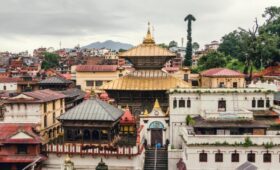
The Kumari the Living goddess lives a secret life without any outside contacts. Kumari is only allowed to have contact with family and close friends. There is always the caretaker presence of Kumari but she is not permitted to speak to outsiders. Kumari lives in Kumari house, “Kumari Bahal” inside the Basantapur Durbar Square, near the palace courtyard.
How is Kumari selected?
Only the pre-pubescent girls from Shakya cast in Kathmandu and Bajracharya cast from Patan and Bhaktapur. who follow Buddhist religion gets chosen to become Kumari. Kumari is the incarnation of goddess Taleju also known as Durga.
It is believed that When the existing Kumari gets her first menstruation the goddesses leave the body of the child and the next one Is chosen to be Kumari. The girl must not have any bruises, cuts, and birthmarks. She should bear the 32 qualities of physical perfection, as well as her horoscope, should perfectly correspond with that of kings.
The candidates for Kumari should undergo various rituals and pass all of them in order to become Kumari. The candidate should not show fear during these tests and rituals.
Ancient Tale
They say that ancient kings were great devotees of the goddess Taleju. As the goddess was happy with them, then she comes down to the palaces. she walks and plays games with the kings. Once a king, while playing and gambling with the goddess, approached with sexual intentions.
The Kumari the Living goddess got enraged with anger and disappear. The king felt bad about his action and prayed for forgiveness. The goddess came in his dream asking him to choose a girl for her to possess and worship her as the goddess incarnation. This tradition is followed from generation to generation. The culture is not transforming throughout time. The kings bowed down every year for the blessing to rule the country.
So why is the tradition of Kumari so important?
The tradition of worshiping little girls as goddess has greater significance than just a culture. Nepal has been a patriarchal society for centuries but the worshiping of female gods shows that we haven’t completely abandoned our ancient heritage.
Even late king Prithvi Narayan Shah knew the importance of this culture. When he was on the mission to unite the kingdom of Nepal he won over Kathmandu.
He saw the two-religion following the same tradition and the indigenous community of Newar following the tradition. He used it as an opportunity to show his loyalty to God and the people of Nepal and bowed before the Kumari for her blessing to rule the kingdom. After end of monarchy and president was chosen, he bowed before the Kumari for the blessing. it is a good thing that in a patriarchal society like Nepal that a female god has such a powerful impact.
Life of kumari
Most of the Kumari have reported the transition from being a goddess to a normal girl. It is a little hard at the beginning but they are able to return to their normal life. This shows that the life of Kumari is not cruel as most people depict it to be.
During the festival of Indra Jatra, the chariot of the Kumari the Living goddess attracts most people than other male gods. As Nepal, being a patriarchal society for a long time, the powerful dignitaries and kings bowing to a small girl is a unique and interesting thing on its own.
The harmony between two different religions just to worship a little girl represents a huge deal of religious uniqueness of Nepal. History is preserved and studied by a large number of people all around the world.
The tradition of Kumari the Living goddess is not only of religious importance. But it represents Nepalese culture and Nepalese people to the world. I think that this culture has preserved the belief of local community. This made people aware of the respect to female . Along promoted the historical as well as the cultural aspect of Nepal to the whole world.